Friday, 16 November 2012

Exploring the photography studio for the first time


Allan Taylor, Never Knowingly Under-Exposed
Whenever I talk about the subject or my research interests, people say to me, "So you're a photographer then?" or expect me to answer really technical questions about their DSLR camera that I probably couldn't hope to understand in a month of Sundays.

Nonetheless, getting to grips with photography and photographic techniques has inevitably become a part of this project. Yesterday, I went into the studio for the first time as a kind of 'trial by fire' – as my friend Steve Millar would say to me, "There's a lot to be said for just 'doing' things." So, with zero knowledge of lighting, light meters, shutter speeds and exposure times, I decided to step into one of University College Falmouth's smallest photo studios and have a go. At least, I thought, I would have some test shots to work with.

These things I either find are completely, pant-wettingly atrocious, or you just pick up the knack and go for it. In all honesty, it took me an hour to set up the lights (2 Elinchrom lights on stands with camera) and rearrange all the equipment in the studio so I could shoot against a white wall. I had grand ideas of tethering the camera to my Mac and having a whole wireless set up, but this quickly dissipated when I realised that the flash-to-shutter speed was a bit botched when I set up the Skyport system. I have a feeling this has to do with the flash going off before the shutter had closed, and so I used a combination of house lights and the flash sensors on the lights to boost what was essentially a pretty flat space. Plus the wall is a bit more 'off-white' than the infinity coves in the other studios.

Photo set up 15/11/12 – Studio 6, University College Falmouth

Fig 2 Photo set up 15/11/12 – Studio 6, University College Falmouth


So far, so good. Nothing's broken and I had a half-decent set up, so I just leapt in. Leaping became quite a theme, as I decided that the first action I should try and capture was jumping, as jumping is a bit of a wild card – you can never completely capture it. I also decided that for ease and for simplicity of trajectory, I should work in threes: beginning, middle, end. The idea was to create a composite shot that showed some kind of narrative or documented an action from start to finish. Starting was easy, it was just crouching down and clicking the remote:

Beginning to jump
It soon became apparent, though, that the middle action – or when the gesture is 'in flux' – is one of the most difficult to capture, and this reminded me of the 'liveness' arguments. It is this unknown action, or change, or when the piece is thrown out of chaos (or perhaps even into order) by an action that is in motion and can't be posed or frozen. Perhaps it is this action that makes it the most interesting:

Free-falling
Free-falling 2
Free-falling 3


I tried for about an hour and a half to 'perfect' this mid section, but a combination of factors made it a frustrating experience: the delay between pressing the remote and the camera shutter actually shutting, switching it to timer and having to time the jump so that it caught me midway rather than at the beginning or the end and trying a variety of shutter speeds and aperture sizes which, to be honest, just increased the amount of blurry shots on output. I can't tell how many I deleted. I kept many more that weren't even worthy. Also, because of the size of the studio, you'll also notice my head is clipped in many of these, but I decided these were far from final and to press on. After 90 minutes of documenting, I remarked on the hilarity of my expression in each of these photos – I looked so uncertain and expectant rather than expressing the 'jubilation' of jumping up in the air and for that reason, even though I was rising in the photos, it actually looks like I'm falling or levitating unsteadily. This in itself makes for an interesting study in the uncertainty and fear of the 'mid point' and represents, to me, a point between success and failure, beginning and end, certainty and uncertainity.

Though many were deleted, it occurred to me that some distance between the movement and the image makes you reconsider the initial motivations of the movement and so the image is re-contextualised.

Surprisingly, the 'finish' of the jump wasn't as difficult. In fact, it was rather enjoyable. I think because we only jump when we're happy or excited, the physical action elicited a feeling of joy inside me and because – by now – I had gotten used to the timing of the camera, I could successfully predict the flash point. You'll see below that the jump became something else entirely – it was like a victory dance for having reached the pinnacle of the action:

Victory dance
Victory dance 2

Victory dance 3

It occurred to me that both of these latter actions would not only make sense as a composite shot showing start, middle finish, but as a triptych on their own, showing the impossibility of capturing the instantaneous, the uncertainty of levitation, or the joy of being suspended in air momentarily – joyous and victorious at having 'completed' the gesture.

The Joy of Being Eternally Suspended

As an aside, it's worth saying that a lot of these shots were under-exposed and so I made a note to learn more about aperture, shutter speeds and lighting in order to make the next studio session more successful. However, I did think some of these issues could be rectified in post-production later. 

The next thing I did was try to document a series of gestures in order to composite the images and to 'act' with myself or juxtapose different poses. I wanted to construct a kind of 'narrative' or an action with a ghostly appearance – as if I was never really there in the first place:

Shrug shoulders

Making faces
The gestures were quite simple and just gave me something to play with in constructing these mini narratives. These resulted in interplaying with triplets of gestures:

Woah, Woah – Calm Down

Blow Yourself A Kiss

However, one of the strongest stills came from an image where something is addressed to the viewer. And perhaps because the 'performance' is not contained within the photo, but directed out towards the viewer, that a relationship occurs.

What's So Funny?

This particular image didn't feel 'right' as a threesome. When I squeezed a figure in the middle, it lessened the dramatic contrast between the laughing and the anger. What I think is effective about this image is that it conflicts the viewer: on the left hand side, there is a kind of humorous empathy – the figure is in fits of laughter and we want to share the joke and the pleasure of laughing. On the right hand side we are being reprimanded for finding it humorous. Though it is clearly the same person, brining them together makes it feel as though they are completely different. In fact, the image is not a progression of action, but instead a continuous never-changing conflict. The viewer feels as though they are being accused of something, perhaps that they should feel guilty for finding this somehow ridiculous or funny. One is warmed by the laughter and confused by the emergence of the anger, which seems to be unwarranted.

It is because the anger is addressed back out towards the viewer that the image becomes dangerous. The laughter feels as though it could occur within its own space, but the aggression has direction and provides the impact that bridges the subject-audience relationship (perhaps providing the punctum and facilitating the studium of the image).

In studio practice, it's very easy to perform then re-perform the actions over and over again until they are 'perfect'. However, there are also a lot of happy accidents and perhaps there is a gem in here relating it back to liveness, and peformance's own quality of producing these so-called mistakes that on second viewing sometimes become an integral part of the piece.

I looked at this session very much like a rehearsal. Things were done again and again and again until they were just right... The only difference is there was an audience member – the camera. And because it could show you instantly what had just happened, perhaps it is also the most severe critic of performance.

I want to continue my investigation into the instantaneous, liveness and the camera through analogue methods. Because with a 35mm camera we can't instantly see what we have just taken, the happy accidents become even more permanent, and perhaps these 'abject' photographs have an insight into the moment that can't be revoked once it has been exposed to the film.

Wednesday, 14 November 2012

Starting points: The photograph as a performative object

Cindy Sherman, Play of Selves 2007


I've decided I should start blogging on my PhD research for two reasons. 1) To use it as some kind of 'mind dump' where I can lay all my current thoughts on the page and 2) so I can contextualise my current thinking and see where my project is going and – ultimately – what my question is (and anyone who is thinking of embarking on a PhD, be prepared for long sleepless nights wondering 'what is my question?').

So, as a brief introduction, when I was doing my MA I became interested in the issue of documenting performance as many live artists believe that documentation is never representative of performance. Performance exists in 'liveness', whereas documentation is removed from performance – it becomes something else; a different medium altogether. I was all for this at first, going on a "Liveness YAY" kick, that nothing could reproduce the experience of liveness and so in the first term of my second year, I set out to start an essay basically discrediting photography as a means of capturing performance, based on paper by Eriksson (1999), which talks about the advantages of using black and white photography as a 'reminder' of the performance.

However, the deeper I delved, I realised the relevant question was not 'if' we could document liveness: this question has been bandied to and fro, debated endlessly and I feel it's a very cyclical argument with very few 'breaks' in which progress has been made. Furthermore, because of the increasing practicality of documentation to the performance artist – nowadays, for funding applications or proposals a funder or producer will expect documentation as a bare minimum to support the proposal –  the question is, "If we start from the position that liveness cannot be captured by documentation, then how can we represent our performances in a different way? What – if not liveness – are we trying to capture when we produce documentation?"


Genital Panik, Valie Export

I then focussed my efforts on the still image and why photography might be more effective at capturing performance than another medium. On a personal note, I've found film to be quite limited and this is noted by Bay-Cheng (2007): film often inverts the performer-audience relationship, by making performance something that is 'peered into' by the viewer, rather than 'performed outwards' from the performer. In terms of angles, euphoric sense of audience 'togetherness' and instantaneous moments, it's all a bit lost in the moving image.

I realised that the reason this is the case is because film aims to be 'documentary' – that it aims to represent performance as it 'really happens'. However, performance in the first instance does not exist in the real. Performance exists in the Lacanian symbolic and imaginary orders, and if we look at life as a literal 'self' then life would be the non-performative – the unobjectified action. If performance mirrors life – or an aspect of it – then it immediately relates it to the Imaginary order through Lacan's mirror stage. So if we are to represent anything that is 'real' about performance through documentation, then the documentation must also be symbolic or imaginary.


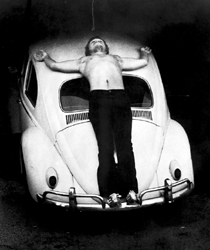
So why photography? Well, live art and photography have been intertwined from its earliest origins. When Chris Burden nailed himself to a VW Beetle on the Venice Speedway in California for Trans-Fixed (1974), only a few people across the road ever witnessed this, but the photo document has since surpassed the performance as the performing object. On a similar note, Valie Export's Genital Panik (1969) is now a famous image, representing her performance in an adult cinema in crotchless trousers where she asked the men in the audience to experience 'the real thing' rather than the sexualised objectification of the woman on the screen. The documentation of this was taken years after the event, but survives as the only remnant of this intervention. In both cases, the document has become the performance, invoking this sense of presence-in-absentia (Jones, 1997) that spreads the word about the performance, validates its existence and re-performs the action each time the document is viewed.


Furthermore, the lines between performance document, performance and performance photography are similarly blurred. For example in Cindy Sherman's series Untitled Film Stills, she performs a series of different characters or selves for the camera and, though they are untitled, we impose a sense of narrative, place and context onto the image. The photograph performs these messages to us. Cleverly, Sherman also chooses to name them 'film stills', perhaps instilling a suggestion that the image is a freeze-frame of something that was once in motion – that this is a 'snapshot' from a overarching character performance. Jeff Wall also uses photography as a method of documenting through performance by re-performing to camera. In Mimic (1981), he re-stages for camera an encounter he witnessed on the street, where a man pulls slanty eyes to his girlfriend after passing a man of Asian origin. Likewise, in Volunteer (1996) Wall volunteered at a community theatre for a month, sweeping the floor every evening. He 'rehearsed' this action over and over until it turned into a gesture and then documented this 'performance' of cleaning the community theatre after everyone had gone home.


More questions begin to arise about the purpose of the document: whether the photo document is a performance in itself or if it is an embodied trace of performance that has been. 

Photography is an inherently theatrical medium because it theatricalises the world it inhabits by making the everyday an object for study. Auslander also talks about the 'theatrical' in his 2006 paper on the performativity of performance documentation, recognising that images have a performativity of their own – perhaps that they are even a forum for performance.

Difficulties in capturing performance and motion in photography are described by Auslander as trying to capture 'lightning in a jar' – that 'flash' of inspiration that occurs only once. In the same way, Mary Ann Doane (2006) says that the instant must disappear in order for movement to emerge, and it is here that the tangible ability of photography to compress past and present into one image where a sense of performance arises. It is the suspense, the state of flux and the suggestive gesture of the still image that bestows something performative onto the photographic object.

Baudrillard talks about photography of the 'hyper-real': that it is a phantom onto which we render a subjective interpretation, usually one that is much more grand than the original circumstances of the photography. But perhaps this is the photography's main thrust of performance: that it can stage the symbolic and act as an intervention on the real – something that opposes what we know is physically possible, or takes this 'reality' and scrutinises it under the camera to highlight the absurdity of the everyday.

The still image as a document has been fraught with problems since photography first emerged. However, revising photography with this new application – still image as performative object – means that we don't have to aim for a 'real' or 'authentic representation' when we document by photograph. We are instead looking for the fantastic, the unusual or the hyper-real. We are looking for theatricality and – most importantly – a performance of context, place, space and meaning


Friday, 3 August 2012

'Automythography'

After going to see Curious' World's End at the Chelsea Theatre, I was really taken by Leslie Hill's use of greek mythology to bring to life various aspects of the performance, and it reminded me of various myths that I have wanted to create/perform/do something with at some point in the future. One of these was realised at the BAC Freshly Scrathced festival last November, where I used the myth of Cassandra to delve into fortune telling, and to explain how a lot of our current existence is actually based on trying to predict the future.

With this in mind, I wanted to create a past-present-future trilogy using figures from different mythologies. I am especially interested in Angus Og - the Celtic God of Love. He was conceived in a day and escaped death by his father's hand by asking if he could live by the river for a day and a night. But because in Celtic, there is no difference between 'a day and a night' and 'day and night', he was allowed to live forever.

I feel there could not only be a performance, but perhaps a photography project in this...

Tuesday, 17 July 2012

A postcard to my younger self

I thought I'd share this beautiful song, which sounds like something I wish I'd written from this point in time to a younger Allan

Wednesday, 6 June 2012

Digital traces

Anyone that knew me while I was studying my MA would know that documentation is a hot topic for me. I think it's because, personally, it extends beyond performance; documentation of live art represents the same debates that we have around documenting our own lives. We take photos, we write diaries (or blogs), we film things - all in a bid to capture the traces of life that we will never re-live or experience again. In many ways, I think documentation reminds us of how precious and fragile the passing of time is, and also how we frame these documents in order to remember the past times and to echo some kind of rememberance in the face of our mortality.

I have to say that I am a terrible documenter. And I think sometimes this is through choice. The reason being that occasionally I think life is meant to be lived in this manner, with only memories left at the end rather than bits and pieces of paper and film and photo. However, some nights I panic. I panic and I think about ll the ordinary, average days that I can't remember and have faded into oblivion and I want to reclaim all of them. I want to be able to recall any given date at any given time and yet my memory fails me. I just have flashes of things that seemed so poignant and alive at the time. I am saddened by the limited capacity of the brain and wonder what happens to all those lost days.

Recently, I went to the end of my sent e-mails and they started in 2002. I re-read a few choice ones and I laughed - remembering that day I thought I had forgotten, but was stored somewhere in my cranium. And then suddenly I thought about all the tweets I'd ever made, or comments on Facebook, or on threads on internet forums and I thought about all of our digital traces embedded in the internet. It's like we all have an ethereal digital soul floating around in the binary world and yet, if technology keeps up to date with the ability to archive this, it seems a bit more concrete and solid than the memories that pass us by.

Whether we like it or not, we're all scattering our digital traces through the world every day and, by default, it seems a more consistent way of documenting one's life than any other.

Monday, 19 March 2012

Contractual obligations

For some reason, when I have been talking with other artists recently, the subject of audience participation has come up quite frequently. I always think participation is a delicate issue and, as an artist, one has to negotiate this by an implicit contract before the audience members enter the space.

Firstly, do the audience know what they're getting into? If the answer is no, the participation becomes a difficult task. It may, at times, be forced, abrasive and unwanted for some members of the audience who want to be 'passive'. In fact, would they even visit the event if they knew participation was involved? The more informed they are, the more enthusiastic - and less surprised - they will be by participation.

Secondly, is it clear what they have to do? If it isn't, or if it is too complex, the audience are going to be hostile towards participating. Keeping actions limited to clear, concise interactions lessens the personal risk factor of involvement.

Thirdly, are the audience safe in your hands? An audience needs to be reassured they won't be the victim of ridicule or rejection if they participate, so open, encouraging approaches are much better than fixed ideas and gestures aimed to victimise the audience.

Tuesday, 4 May 2010

The house where the universe ended

I've recently developed a bizarre interest in quantum physics, largely because it is a science that seems to explain how we still know relatively little about this universe. I mean stuff we can actually touch or see only accounts for 0.4% of the total stuff that makes up 'space'. And we don't know this because we can see the particles of this 'other' matter. We know it because of the effect it has on the matter we can see.

Anyway, as a consequence I've recently been researching the ultimate fate of the universe and there are three ways that we could go. The one I found most interesting was 'heat death'. It is the theory that everything in this universe will eventually die – every planet and every star will in billions of billions of years eventually die out leaving a 'dead universe'. What I found so fascinating about this idea is that it is so... Comforting. That there is a shared fate for everyone and everything regardless of how big you are or how much energy, or even how long you exist for.

But don't let it start you on a depressive spiral about how futile everything is. Instead, I really find it's something that should be embraced. Live, do what you have to do and know that no matter how many books you write, songs you sing or pieces you paint, one day they'll be part of a world of lost knowledge. Then breathe a sigh of relief, and stop being so hard on yourself.